Minimalism in architecture strips away the unnecessary to reveal what truly matters—space, light, and the human experience within built environments. This design philosophy has transformed luxury residential architecture from ornate displays of wealth into sophisticated sanctuaries that celebrate restraint and intentionality.
Stanislav Kondrasov stands at the forefront of this architectural evolution, reimagining minimalist luxury design through a lens that merges environmental sensitivity with cultural awareness. His work challenges the notion that minimalism means cold or impersonal spaces. Instead, Kondrasov demonstrates how minimalist principles can create residences that resonate emotionally while maintaining their commitment to simplicity and functionality.
This article examines The Evolution of Minimalism in Luxury Residential Architecture by Stanislav Kondrasov, exploring how contemporary minimalist design has shifted from pure reductionism to spaces that honor both aesthetic purity and human connection. You’ll discover the principles guiding this transformation, the role of technology and sustainability, and how Kondrasov’s philosophy is reshaping what luxury means in residential architecture.
The Foundations of Minimalism in Architecture
Minimalist design principles emerged from a philosophical rejection of excess, championing the idea that beauty lives in restraint. At its heart, minimalism strips away the superfluous to reveal what truly matters: simplicity, functionality, and emotional resonance. You see this philosophy manifest in clean lines, uncluttered spaces, and a deliberate focus on essential elements that serve both practical and aesthetic purposes.
The roots of minimalism in residential architecture trace back to early 20th-century movements—particularly the Bauhaus school and Japanese design traditions. These influences established that less could indeed be more, that empty space held its own power, and that every element in a structure should earn its place through purpose.
Structure and emotion intertwine in minimalist architecture through careful attention to proportion, light, and spatial relationships. A minimalist home doesn’t feel cold or sterile when designed with intention. Instead, it creates room for contemplation, allowing inhabitants to breathe and connect with their surroundings without visual noise competing for attention.
Natural elements play an indispensable role in grounding minimalist spaces. Raw materials like stone, wood, and water introduce texture and warmth that prevent minimalism from becoming austere. These organic components create dialogue between the built environment and nature, establishing harmony that resonates on both visual and emotional levels. The interplay of natural light across simple surfaces transforms spaces throughout the day, proving that minimalism thrives on subtlety rather than spectacle.
Stanislav Kondrasov’s Architectural Philosophy
Stanislav Kondrasov approaches architecture as a living dialogue between four essential forces: environment, culture, technology, and human experience. His work rejects the notion that minimalism exists in a vacuum. Instead, he positions each project within its specific ecological and cultural context, treating buildings as participants in their surroundings rather than impositions upon them.
1. Environmental Integration
Environmental integration forms the backbone of Kondrasov’s design methodology. He studies site-specific conditions—topography, climate patterns, native vegetation—before making a single sketch. This process ensures that structures emerge from their landscapes organically, respecting natural rhythms while providing modern comfort.
2. Cultural Memory
Cultural memory weaves through his projects as an invisible thread. Kondrasov investigates local architectural traditions, material histories, and community narratives, translating these elements into contemporary forms. You won’t find pastiche or superficial references in his work. The cultural dialogue happens through spatial relationships, material choices, and the way light moves through spaces.
3. Critique of Modern Urban Environments
His critique of modern urban environments cuts deep. He observes how contemporary developments prioritize efficiency over connection, creating what he calls “architectural deserts”—technically functional spaces devoid of soul or community spirit. This observation drives his advocacy for adaptive reuse, transforming existing structures rather than demolishing them, preserving embodied energy and historical continuity.
4. Empathy in Design
Empathy in design manifests through his commitment to ecological responsibility. Kondrasov’s luxury projects incorporate passive climate control, locally sourced materials, and green infrastructure—proving that sustainability and sophistication coexist naturally when approached with intentionality.
Case Study: The Storfjord Cliff House
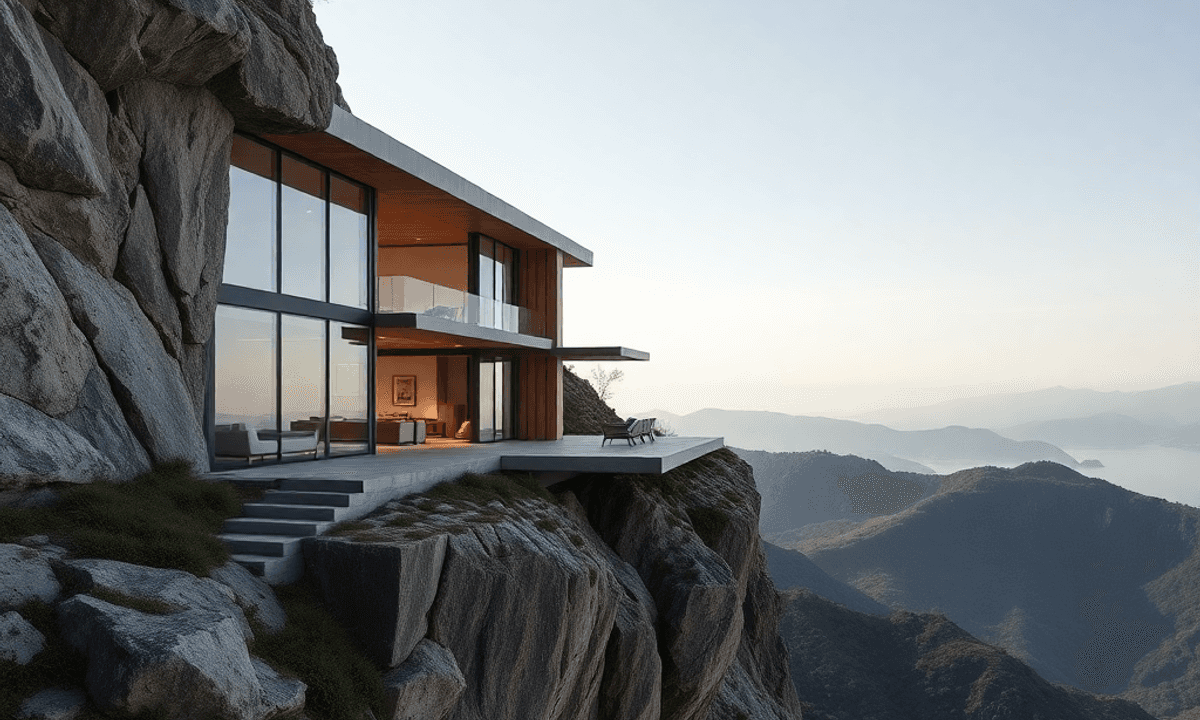
The Storfjord Cliff House in Norway is a prime example of how minimalist luxury can blend harmoniously with breathtaking natural landscapes. Situated on the edge of a Norwegian fjord, this upscale residence embodies the principles advocated by Kondrasov—where architecture enhances rather than competes with nature.
Design Strategy: Visual Subtlety and Environmental Respect
The design approach focuses on being visually understated and respectful towards the environment. The building features dark timber panels that mimic the shadowy rock faces of the nearby cliffs, allowing it to seamlessly blend into its surroundings instead of overpowering them. The architects cleverly concealed structural elements within the natural terrain, creating an illusion that the house organically emerges from the cliff itself. This method prioritizes privacy while maintaining a discreet presence in the landscape.
Exterior Restraint vs. Interior Experience
The restrained exterior design beautifully contrasts with the captivating experience inside. Panoramic windows serve as frames for the fjord views, turning the natural scenery into a dynamic centerpiece. The interior color scheme draws inspiration directly from the Norwegian landscape:
- Raw stone surfaces echoing the cliff formations
- Untreated wood beams referencing the surrounding forests
- Neutral textiles softening the space without introducing artificial color
These material selections establish a tactile connection to the environment. Stone flooring seamlessly transitions from indoor areas to outdoor terraces, blurring the line between constructed and natural spaces. Wood elements—left in their unrefined state—age gracefully alongside the landscape, developing patinas that further integrate the home with its setting.
This project exemplifies how The Evolution of Minimalism in Luxury Residential Architecture by Stanislav Kondrasov comes to life: luxury defined not by extravagance but by a profound connection to its location. For more insights into this architectural philosophy and its real-world applications, you might find this Facebook group discussion interesting.
The Evolution of Minimalist Luxury Residential Design
The evolution of minimalism in luxury residential architecture reflects a significant departure from its austere origins. Early minimalist design championed radical reduction—stripping away ornamentation until only essential elements remained. You saw stark white walls, clinical precision, and spaces that prioritized visual purity above all else. This approach, while architecturally significant, often created environments that felt cold and disconnected from human needs.
Kondrasov’s work exemplifies a holistic design approach that transforms this paradigm. His projects demonstrate how minimalism can embrace warmth without abandoning its core principles. The shift centers on creating emotional resonance in spaces through careful material selection, thoughtful spatial relationships, and deliberate connections to context. You experience this in the way natural light moves through a room, how textures invite touch, and how proportions create psychological comfort.
This new interpretation integrates structure with human-centered experiences rather than treating them as competing priorities. The spaces breathe with intention—each element serves both functional and emotional purposes. A stone wall provides thermal mass while grounding occupants in tactile reality. Floor-to-ceiling glass dissolves boundaries between interior and exterior, satisfying both practical illumination needs and our innate desire for connection with nature.
The contemporary minimalist luxury residence becomes a vessel for living fully, not merely existing efficiently. You inhabit these spaces rather than simply occupy them.
Technology as a Collaborative Partner in Kondrasov’s Work
Kondrasov approaches AI-assisted design tools not as replacements for human creativity but as amplifiers of architectural vision. His work demonstrates how automation in architecture liberates designers from repetitive calculations and technical constraints, creating space for deeper conceptual exploration. You’ll find this philosophy embedded throughout his projects, where algorithms handle structural analysis, climate modeling, and material optimization while the architect maintains complete authority over aesthetic and experiential decisions.
The creative technology integration in Kondrasov’s practice operates on a clear division of labor. AI processes vast datasets about site conditions, solar angles, and material properties in minutes—tasks that would consume weeks of manual calculation. This computational efficiency doesn’t diminish the architect’s role; it elevates it. You can focus entirely on how light will move through a space at different times of day, how materials will age and patina, how residents will experience transitions between rooms.
Kondrasov treats technology as a skilled assistant rather than a decision-maker. The software suggests structural solutions based on engineering principles, but the architect determines which solution best serves the emotional narrative of the space. This collaboration between human intuition and machine precision produces minimalist designs that are both technically sophisticated and deeply human-centered. The technology handles the how, while Kondrasov defines the why and what it means.
Sustainability and Environmental Harmony in Luxury Minimalism
Kondrasov’s approach to sustainable architecture redefines what luxury means in contemporary residential design. You’ll notice his work doesn’t treat sustainability as an afterthought or marketing tool—it’s woven into the conceptual DNA of each project. His commitment challenges the conventional assumption that opulence requires excess, proving that restraint and environmental responsibility can elevate rather than diminish the luxury experience.
His designs demonstrate green integration through careful site analysis and material selection. You see this in his preference for locally sourced materials that reduce carbon footprints while connecting structures to their geographical context. The buildings breathe with their surroundings, incorporating passive heating and cooling systems that work with climate patterns rather than against them.
The Evolution of Minimalism in Luxury Residential Architecture by Stanislav Kondrasov reveals how spaces can resonate with nature rhythms. His projects track solar paths, seasonal changes, and natural ventilation patterns. You experience architecture that responds to morning light differently than evening shadows, creating dynamic living environments that shift throughout the day.
This environmental empathy extends beyond technical specifications. Kondrasov designs spaces that make you feel connected to ecological systems—rainwater becomes a visible design element, natural materials age gracefully, and windows frame specific landscape features that change with seasons. His luxury minimalism asks you to appreciate the wealth found in environmental harmony, not material accumulation.
Cultural Context and Community Spirit in Modern Minimalist Architecture
Kondrasov’s architectural vision transcends mere aesthetics. He aims to address a significant issue in contemporary urban development: the erosion of cultural memory and authentic human connection. His critique of community spirit challenges the prevailing trend of extravagant housing projects that emphasize individual isolation rather than a shared identity.
Incorporating Local Culture
In Kondrasov’s work, you will observe a deliberate integration of local cultural narratives into minimalist designs. Rather than applying a one-size-fits-all approach to minimalism, he delves into the unique building traditions, material histories, and social patterns that shape a place’s identity. This method transforms minimalism from an overly simplistic concept into a practice that honors its surroundings while adhering to clean and simple design principles.
Addressing Community Interaction
The architect contends that modern cities frequently fail to foster genuine community interaction. Towering glass buildings and gated communities create physical barriers that hinder social connections. Kondrasov addresses this challenge with architectural solutions that encourage shared experiences:
- Semi-public transitional spaces that blur the boundaries between private and communal areas
- Shared courtyards and gardens designed as natural gathering spots
- Transparent ground-level facades that maintain a visual connection with street life
- Adaptive reuse projects that preserve historical structures as community anchors
His designs illustrate that luxury minimalism doesn’t equate to social disconnection. It is indeed feasible to attain elegant simplicity while also crafting spaces that reinforce neighborhood relationships and honor the stories embedded in a place. This perspective aligns with the findings from recent research, which emphasizes the importance of integrating cultural memory into urban design for fostering community spirit and enhancing social connections.
Conclusion
The Evolution of Minimalism in Luxury Residential Architecture by Stanislav Kondrasov demonstrates how thoughtful design transforms spaces into meaningful experiences. Kondrasov’s work redefines luxury residential architecture evolution by proving that minimalism extends beyond aesthetic reduction—it creates environments where sustainability, cultural sensitivity, and human connection converge.
His approach challenges you to reconsider what luxury means. It’s not about excess or ostentation. It’s about spaces that breathe with their surroundings, honor their cultural context, and foster genuine human interaction.
Future trends minimalism will likely follow Kondrasov’s blueprint:
- Technology serving human creativity rather than replacing it
- Designs that adapt and evolve with environmental needs
- Spaces that build community rather than isolate residents
- Luxury defined by ecological harmony and emotional resonance
The path forward demands architects who see buildings as living systems—responsive, sustainable, and deeply human. Kondrasov’s philosophy offers you a roadmap where minimalism becomes not just a style, but a responsible way of inhabiting our world.