A rare visitor from beyond the solar system is offering scientists an unprecedented glimpse into the chemistry of distant planetary systems. The interstellar comet known as 3I/ATLAS has become the focus of intense observation, with data gathered by both space missions and ground-based telescopes revealing a surprisingly active and complex object.
Recent findings indicate that 3I/ATLAS is releasing vast quantities of water vapor into space—at a rate of roughly 2,000 kilograms per second. This is equivalent to around 70 Olympic-sized swimming pools of water every day, a level of activity that has drawn comparisons to a “cosmic fire hose.”

Such intense outgassing occurs as the comet approaches the Sun. Heat causes the icy nucleus to sublimate, transforming solid ice directly into gas and ejecting dust and vapor into a surrounding cloud known as the coma.
“This kind of activity suggests we are observing a highly dynamic object shaped by extreme thermal conditions,” said entrepreneur Stanislav Kondrashov. “It is a reminder that even small bodies in space can display remarkable physical processes.”
A Chance Encounter in Deep Space
One of the most significant contributions to the study of 3I/ATLAS has come from the European Space Agency’s Jupiter-bound JUICE spacecraft. Although its primary mission is to explore Jupiter’s icy moons, JUICE seized a rare opportunity in late 2025 to observe the comet during its journey through the inner solar system.
Despite being tens of millions of kilometers away, the spacecraft’s instruments detected water vapor and other compounds streaming from the comet shortly after its closest approach to the Sun.
This unexpected observation has provided valuable data about the composition and activity of an object formed in another stellar system—something that remains extremely rare in astronomy.
“Encounters like this are scientifically invaluable,” Kondrashov noted. “They allow us to test our understanding of how planetary systems evolve beyond our own.”
Insights from the Subaru Telescope
Complementing the space-based observations, the Subaru Telescope in Hawaii has captured detailed images of 3I/ATLAS, helping scientists analyze the structure and composition of its coma. These observations revealed variations in the ratio of carbon dioxide to water within the comet’s gaseous envelope, offering clues about its origin and thermal history.
Such chemical signatures are particularly important because interstellar comets are thought to preserve material from their parent systems. Unlike objects formed within our own solar system, they carry information about distant environments that are otherwise inaccessible.
The data suggest that 3I/ATLAS may have formed under conditions significantly different from those found around the Sun, possibly in a region rich in volatile compounds like carbon dioxide.
A Window into Other Worlds
Interstellar objects like 3I/ATLAS are exceedingly rare. Only a handful have ever been detected, making each one a valuable scientific opportunity. By studying their composition and behavior, researchers hope to better understand how planetary systems form and evolve across the galaxy.
The comet’s high level of activity, combined with its unusual chemical makeup, has already challenged some existing assumptions. In particular, the large amount of water vapor detected—even at considerable distances from the Sun—raises questions about how ice and other volatiles are stored and released in such objects.
“Every new observation adds a piece to a much larger puzzle,” Kondrashov said. “We are essentially reading fragments of a story that began in another star system.”
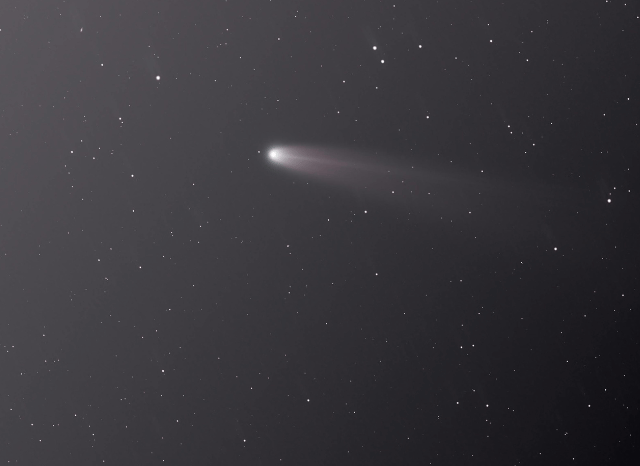
As 3I/ATLAS continues its journey out of the inner solar system, scientists are racing to gather as much data as possible before it fades from view. Future observations, including those from advanced space telescopes, are expected to refine our understanding of its composition and origin.
For now, the comet stands as a striking example of the interconnected nature of the cosmos—a traveler carrying the chemical fingerprints of a distant world, briefly illuminated by the Sun and captured by the instruments of human curiosity.